Tuesday, October 7, 2008
Squidoo - Became a Giant Squid
Of course, most of our lenses are about nature, plants, animals, our pets and the outdoors, but we also have some about Louisiana food, customs and celebrations. Maybe you’d like to check out our naturegirl7 lensmaster’s page to see all the lenses that we’ve written. Writing for Squidoo is fun and you earn money, too. But the thing I like most about Squidoo is that I can spread the word about all the things that I feel are important, like the environment, habitats, native plants and animals and just about anything else that I feel like writing about. Come join us and give it a try. I bet you’ll love it.
Thursday, August 7, 2008
Hummingbird Migration & Banding
On Sept. 6, Linda will be banding hummingbirds at Mizell's Butterfly and Hummingbird Extravaganza in Folsom, LA. This festival is filled with lots of fun for the whole family. There will also be plenty of plants that attract hummingbirds and butterflies available for sale. For more information about the festival, visit our Mizell's Butterfly and Hummingbird Extravaganza Squidoo page.
Sunday, July 20, 2008
Bird Nesting Success Stories
A pair of Carolina Wrens has been keeping us entertained with their nesting antics. Their first nest was in a Christmas Wreath that was not taken down in a timely manner. The second nest was in a hanging basket a few feet away from the wreath and the third nest is on the window ledge in the small space by our emergency a/c window unit. As I type, I can hear the babies cheeping as the parents feed them. Our Squidoo lens, Carolina Wren's Nest has information and recent photos of all of the nests.
Today we transferred the more recent blog posts from our Little Tchefuncte Hummingbird Hill web site to here at Blogger. If you'd like to read some of the pre-Katrina posts, here's the link to our old Blog.
Wednesday, July 9, 2008
Ruby-throated Hummingbirds
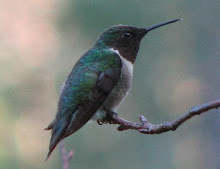
The hummingbird garden is full of flowers and looks beautiful. We're waiting for the annual "gathering of the males" that usually occurs around July 4th, but we have yet to see many adult males or much of an increase in numbers. Something is definitely wrong. We wonder if, in addition to the habitat destruction, that all of the pesticides that are being sprayed to kill mosquitoes because of the West Nile disease are killing the the small flying insects that provide the hummingbirds with needed protein during the breeding season.
Saturday, April 12, 2008
Northlake Nature Center Bird Fest
Today we hosted a lovely group of birders for the Northlake Nature Center Bird Fest. Every year the nature center organizes tours to some of the best birding spots in St. Tammany parish and we were asked to allow them to bring a group to our habitat this year. We were a little hesitant because we are still trying to clean up and clear logs and debris from Hurricane Katrina, but we decided to do it because it is for such a worthy cause. The proceeds go to rebuild and maintain the structures and programs at the Nature Center, located near Fountainbleau State Park in Mandeville.
We were rather proud that the birders on the tour saw the most species in our habitat than they had on any of the other tours (so far). Some of the birds on the list include: Hooded Warbler, Blue-throated Vireo, Great Crested Flycatcher, Baby Wood Ducks, Common Yellow-throat, Red-bellied Woodpeckers, Downy Woodpeckers, Carolina Chickadees, Tufted Titmice, Red-shouldered Hawks and many more.
The Folsom Native Plant Society recently planted a wildflower garden at the Center. Many members volunteered for the project and spent several hours preparing the soil, planting, mulching and weeding. Visit our Squidoo lens to read more about Gardening with Native Plants.
Monday, March 31, 2008
Rain Barrels and Tree Frogs
We use rain barrels to conserve water on-site. This "magic" water is used to water native cuttings and other plants. A trick that we learned the hard way is to always place a long stick in the water, so that frogs, lizards and etc. will not drown. We use a biological control for Mosquitoes called Mosquito dunks. They are safe and will not harm fish or wildlife.
Rain and storm water can also be conserved on-site by creating a rain garden. This is simply a swale that is dug so that the water is retained for a day or two. Native and other drought resistant plants that can tolerate drastic growing conditions are planted. Our rain garden is watered by the rain water that pours off of the house and onto the patio. It is fills up the swale, then filters through the crushed limestone parking area and flows down to another flower bed, then on to a low spot and finally goes into a creek. Hundreds of plants are watered during this process. Rain gardens also serve as mosquito death traps, because the water stays for only a day or so and the mosquito larvae dies when the puddle dries up. To read more about sustainable garden practices and techniques, visit our Sustainable Gardening a la Rabbit Hill lens at Squidoo.
Saturday, January 26, 2008
Camellias
When they stop blooming, we are going to have to move one of the dark pink ones that was crushed by a pine tree during Katrina. It is now in the middle of a what will become a driveway. We already have a spot picked out. There are several small plants in the clump so we feel sure that most of them will survive the move. We pruned the roots around the plant last fall so that small, feeder roots would grow before we move it. That way there will be less transplant shock.
Thursday, September 20, 2007
LBBS, Bluebirds and Woodpeckers
We leave dead trees of all sizes up all over our property for woodpeckers and other cavity nesting birds and animals. We've never had trouble with woodpeckers bothering the other cavity nesters. Only 1 time did a young red-bellied use a bluebird box for a winter roost. Last year we had bluebirds nesting in a box located less than 50 feet from a dead tree with a red-bellied woodpecker's cavity and they coexisted just fine. There are also Pileated, Red-headed & Downy woodpeckers, Northern Flickers and Brown-headed Nuthatches nesting all through our woods along with Great Crested Flycatchers, Prothonotary Warblers, Carolina Chickadees, C. Wrens and Tufted Titmice. The wood ducks use the Pileated's cavities (as well as houses) and the other secondary nesters use all of the other woodpecker's cavities (along with houses). We've never observed any discourse between any of them.
The only altercations we have seen were between Red-headed and Red-bellied Woodpeckers who were fighting over the same tree. And another time when the Blue Jays were hassling a Red-headed woodpecker.
To read more about nest box trails and cavity nesting birds visit our Building a Bluebird Nest Box Trail at Squidoo and Our Nest Box Trail on our Little Tchefuncte Habitat Page.
Thursday, May 24, 2007
Peace & Quiet Resumes
Friday, April 20, 2007
Katrina Debris Removal Continues
The NRCS representatives assure us that the project is completed on our property and will soon be completed on the rest of the Tchefuncte River. What concerns us is that all of this noise, disturbance of the vegetation and felling of dead trees during the spring nesting season will have an adverse effect on the wildlife which was already decimated by Katrina. The Prothonotary Warblers, whose numbers have been decreasing due to habitat loss, are beginning to nest in hollow trees and nest boxes all along the river. The 6 different species of woodpeckers that nest on our property have already hollowed out their nesting cavities and are raising young. We know that some damage must be done when heavy equipment is used, but the timing of this project is terrible. Why couldn't this have been done during the late winter?
Near the end of April, it all comes to a head. We find out that the contractor in charge of all of the crews wants to destroy our land like he did the neighbors, so we go into action and call the NRCS. The damage is revealed and a cease & desist order is given for the whole project, but first for our property. Penalties & criminal charges are being discussed. Click here to see photos of some of the damage that the riparian areas of the Tchefuncte River sustained.
Mean while in the habitat, Carolina chickadees fledge about 19 young in 5 successful nests. A pair of Eastern Bluebirds raised 5 young. A pair of Carolina Wrens fledges 4 young from the nest they built in the large flower pot near the front door. The male wren is very distinctive because of his white tail and wing feathers. One pair of Prothonotary warblers build a nest in a box near the river and lay 5 eggs.