Showing posts with label habitat destruction. Show all posts

Friday, April 20, 2007

Katrina Debris Removal Continues

For the past 3 weeks, since April 4th, we have been enduring another Katrina debris removal project on the Tchefuncte River. We have been cooperative by letting the sub-contractor use our little road through the woods, but we have still lost some healthy native trees and shrubs as well as some things that we planted. The Tchefuncte is protected under the Louisiana Scenic Rivers Act as well as a Federal Clean Rivers Act, but the parish council has renewed an emergency order each month since it was enacted soon after Hurricane Katrina.

The NRCS representatives assure us that the project is completed on our property and will soon be completed on the rest of the Tchefuncte River. What concerns us is that all of this noise, disturbance of the vegetation and felling of dead trees during the spring nesting season will have an adverse effect on the wildlife which was already decimated by Katrina. The Prothonotary Warblers, whose numbers have been decreasing due to habitat loss, are beginning to nest in hollow trees and nest boxes all along the river. The 6 different species of woodpeckers that nest on our property have already hollowed out their nesting cavities and are raising young. We know that some damage must be done when heavy equipment is used, but the timing of this project is terrible. Why couldn't this have been done during the late winter?

Near the end of April, it all comes to a head. We find out that the contractor in charge of all of the crews wants to destroy our land like he did the neighbors, so we go into action and call the NRCS. The damage is revealed and a cease & desist order is given for the whole project, but first for our property. Penalties & criminal charges are being discussed. Click here to see photos of some of the damage that the riparian areas of the Tchefuncte River sustained.

Mean while in the habitat, Carolina chickadees fledge about 19 young in 5 successful nests. A pair of Eastern Bluebirds raised 5 young. A pair of Carolina Wrens fledges 4 young from the nest they built in the large flower pot near the front door. The male wren is very distinctive because of his white tail and wing feathers. One pair of Prothonotary warblers build a nest in a box near the river and lay 5 eggs.

Wednesday, September 13, 2006

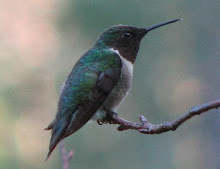
Ruby Throat Hummingbird Migration, Kingfisher and Habitat Destruction

Linda and I banded ruby throated hummingbirds this morning. This is fall migration and a new wave came in ahead of the little cold front. This morning was our best in many months with 34 new captures. There were several females, adult males and many immature males. On our walk to the river we saw a Belted Kingfisher dive into the water after a fish.

The St. Tammany Parish / NRCS stream debris removal and destruction project seems to be coming to an end by our property. They agreed to stop before our property line thus saving a large area of important hummingbird breeding and nesting habitat.

We weren’t so lucky with the new neighbor who bought the land across the river and who just finished bulldozing hundreds of native shrubs and trees all along the Tchefuncte. Now bare dirt that will be susceptible to soil erosion is where wild blueberries / Huckleberries (Vaccinium spp.), native azaleas, strawberry bushes and arrow-wood viburnums full of fruit once stood. Over 30 different species of birds and many mammals could have used that fruit since Katrina had already destroyed so much of the food supply and habitat. We are also concerned about the hit that the fish and other organisms in the river will take when the rains and resulting yearly winter & spring floods wash the soil from the bare land into it.

Sunday, October 2, 2005

Nest Box Trail Update

We've come up for air after a month of cutting and clearing fallen trees. We still haven't cut our way to check on all of the houses, but so far about 7 bluebird sized boxes were damaged and our new cypress wood duck box was knocked off the pole and the roof will need repair.

We are very concerned about the number of large black cherry trees that were up-rooted or broken. So many of the cavity nesters use these berries as a food source. We lost many oaks and have pine snags all over our property. To look on the bright side, it opened up the woods more so that more bluebirds may be attracted and the snags will provide places for woodpeckers to nest in the future, but the devastation is hard to believe.

We do have electricity now (ever since Sept. 18th) so we don't have to play generator tag with the water well pump and the refrigerator. It's so nice to be back in civilization, but we'll probably smell like chain saw smoke and wood chips for a couple of years! We were very lucky and our hearts go out to the people and the wildlife in the hard hit areas south of us. Our habitat will rebound. New growth is already sprouting up through the debris. We just need a little rain to clear things out. It was lucky that the storm hit at the end of the breeding season so that no nests were lost. Nestboxes can be repaired.

Sunday, September 18, 2005

3 Weeks of Misery

The Electricity was restored today. Tears came into my eyes when I saw those big orange trucks come to our house. We have been surviving on MRE's and the water and ice that we get from the relief station. There has been no rain since Katrina and it's extremely hot. With the help of our family and a church group, we've been able to clear the trees from around the house and have gotten them out of the pond, but not before there was a fish kill. We also cut a walking trail to the river where there was a massive fish kill. At least we can put food out to help the animals down in the woods. It's going to take years to get our habitat to normal, but it will never be like it was before.

During the storm, the migrating ruby-throated hummingbirds fed from the feeders that we had wired down. Cardinals, doves, chickadees and tufted titmice fed from the seed feeders. None of the feeders were damaged, but many of the nest boxes on our trail were torn apart or knocked down. Luckily, most of the cavity dwellers had finished nesting before the storm hit. Many of the dead pines that were used by woodpeckers were blown down. While we'll have plenty of trees to replace them in a few years, a nesting cavity shortage will occur next spring, because many need partially decayed wood to hollow out their cavities.

Another repercussion of the downed trees is a shortage of food for wildlife. Black cherries are one of the most widely used berries and are eaten by over 30 species of birds and many mammals. Oaks also provide food in the form of acorns for all kinds of animals. Many of the smaller food bearing trees like sassafras, black gum and yaupon were also destroyed. It will take years for the small trees that are left to grow enough to provide the same amount of food that the downed ones did.

Our pets have suffered a lot, especially our 14 year old cat. The generator would only run a small window a/c unit for part of the house where our 2 dogs are. She doesn't like the dogs, but finally couldn't take the heat anymore and came in with the rest of us.