Showing posts with label nest box trail. Show all posts

Wednesday, May 13, 2009

Prothonotary Warblers are Back


This is the first time that we have been able to monitor each of the boxes on our nest box trail since late April. Many Carolina Chickadees and some Carolina Wrens have fledged. Now the Prothonotary Warblers are back and have set up housekeeping in our Backyard Habitat along the Tchefuncte River. For more information about the lovely golden yellow Prothonotary Warblers, visit our Prothonotary Warblers are Golden lens. Here are the results of the monitoring that we did today:

Box # ----- Bird, Eggs, Young

2 ----- Carolina Wren - Nest fills the box
5 ----- Flying Squirrel nest with squirrel holding on to the door when I opened it. Should have hung a Do Not Disturb Sign.
6 ----- Prothonotary Warbler - 4 eggs with hen sitting
8 ----- Carolina Chickadee - 4 young fledged
9 ----- Carolina Wren? - moss with leaves on top, unfinished
11 ---- Carolina Wren - 4 young fledged
16 ---- 2 inches of green moss
21 ---- 1 inch of green moss with indentation
22 ---- Carolina Chickadee - 4 young fledged
24 ---- Carolina Chickadee - 4 young fledged
25 ---- Prothonotary Warbler - hen sitting on 4-5 eggs
26 ---- Prothonotary Warbler in old wren house that can't be monitored

Wednesday, April 22, 2009

Nest Box Trail Monitoring 4/21-22


We try to check the nest boxes on our Cavity Nesting Trail about once a week, but because of "life", we are lucky to check them every 2 weeks. For more information about Bluebirds and nest box trails, visit our Nest Box Trails for Bluebirds and Others page. This monitoring session, we observed:

Box Number ----- Bird, Eggs, Young

1 ----- Carolina Chickadee: 4 young fledged
6 ----- Nest of leaves and Cypress bark
8 ----- Carolina Chickadee: 4 young, fully feathered
11 ---- Carolina Wren: 4 young, few days old
18 ---- Carolina Chickadee: 2 young fledged
20 ---- Eastern Bluebird: 4 young fledged
22 ---- Carolina Chickadee: 4 young with feathers
24 ---- Carolina Chickadee: 4 young, some feathers

Friday, April 10, 2009

Nest Box Trail Monitoring Results


We checked all of the nest boxes on our trail this morning. Despite the abnormal weather fluctuations, most of the nests were successful and there are a few new nests. Here is a quick run down of what we found.

Box #
1... (4) Carolina Chickadee babies are fully feathered
4... (4) Carolina Chickadee babies fledged
6... A nest of leaves & Cypress bark that could belong to Great Crested Flycatchers
7... (1) dead Carolina Chickadee, probably weather related
8... (2) just hatched Carolina Chickadees & 5 unhatched egg w/ Mom sitting
11.. Carolina Wren nest with 5 eggs
12.. Flying Squirrel nest with Squirrel
16.. Some green moss, maybe Prothonotary Warbler
18.. (2) Carolina Chickadee, fully feathered babies
20.. (4) Eastern Bluebird, w/ feathers & pins on head & back
22.. Carolina Chickadee, 5 eggs, Mom sitting
24.. Carolina Chickadee, 5 eggs

As you can see, the Carolina Chickadees are the first to nest on our trail and the Eastern Bluebird is not far behind. Since most of our boxes are in wooded areas, there are fewer Bluebirds. Bluebirds like more open, field like areas. The Prothonotary Warblers just returned from their wintering grounds in the south and the males are showing the females all the available real estate. Spring is indeed here in our habitat on the Little Tchefuncte River.

Thursday, April 9, 2009

Spring in Little Tchefuncte Habitat


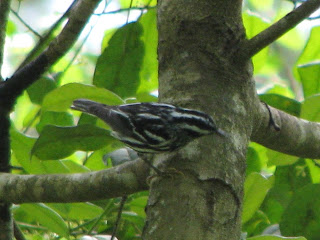
Black and White Warbler

We've been so busy with many conservation efforts, that I haven't had time to write anything for months. So.... this will probably be a long post.

Our nest box trail is doing well this spring. There are 5 boxes occupied with Carolina Chickadees and 1 with Eastern Bluebirds. We plan to check the boxes again tomorrow, if it doesn't rain. All the eggs that were laid when we last checked, have hatched and we've observed the bluebirds feeding their young.

We've had an abundance of rain (all at one time) this year. Recently we received almost 7 inches in 2 days. We are no longer below the average rainfall, but the deluge was followed by several days of strong winds which dried everything out, so we really could use another rain.

The strong winds continue to break tree limbs that were damaged during the December snowstorm and the hurricanes. We are constantly clearing trails in the woods and in our yard.

We've seen some interesting and beautiful animals and birds recently. Yesterday, while we were down by the river, we observed a Black and White Warbler, Prothonotary Warbler, Pileated and other Woodpeckers, and several Wood Ducks. Indigo Buntings and some other migratory birds have been visiting the feeders near the house.

A few days ago, Al saw a mother Wood Duck and 15 ducklings in our pond by the house. Apparently they had hatched from the box that we put up there. By the time he had put the dogs inside and grabbed his camera, they were gone. Those mother Wood Ducks are like drill Sergeants. She lined them all up and led them far away to the other side of the pond from Al, then as soon as he left, she must have taken them into the bushes and told them to lie low.

Late yesterday afternoon, I was looking out of the French doors in the front of the house and was surprised and pleased to see a Wild Turkey cautiously stroll into the gravel part of the circular drive. She (I think) was looking straight at me so I couldn't move. I asked Al to get the camera, but by the time he found it, the turkey had stepped back behind some bushes. I went out and did see it walking toward the wetlands area by HWY 190, but couldn't get a photo. Even though we haven't been able to photograph the Wild Turkeys, it's great to know that there are still some around. With all the habitat destruction and urban sprawl, the large tracts of land that are needed for these large birds have been cut into small islands, which reduces the population that can be supported.

Tuesday, June 13, 2006

Prothonotary Warblers, Great Crested Flycatchers & Eastern Bluebirds

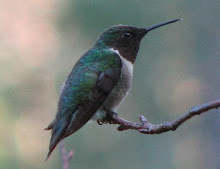
This morning we attempted to band ruby-throated hummingbirds. This is a very inactive time for banders, when trapping is difficult due to the large number of flowers blooming - mimosa, Japanese honeysuckle, lemon bottlebrush and trumpet creeper, to name a few. The female ruby-throats have also been tending their first nests. A few juveniles have been sighted so in the next couple of weeks the hummingbirds will be plentiful again.

After a slow start, the nestboxes on our small trail had a high percentage of occupancy this year. This was probably due to the fact that most of the natural cavities were knocked down by H. Katrina. Five pairs of Carolina chickadees had successful nests, which was such good news because they haven't been doing well the last few years.

Three different pairs of Prothonotary warblers were successful: 1 in a bluebird box, 1 in a chickadee size box & 1 in an ornamental old barn wood box on our front porch. I have pictures of the pair on the front porch. It looks like they are starting a 2nd nest, too.

A pair of Great Crested Flycatchers built in a screech owl sized box in the vegetable garden and the last of their young are fledging as I write. We found what we think is a great crested flycatcher's nest in box #13. We are unable to check it regularly because you have to scale 4 fallen trees and balance on logs to reach it. It also has never had a nest in it until this year. We considered making it box 12b, but maybe it's not jinxed after all.

After a successful 2nd nesting attempt producing 4 fledglings (I saw them on the wire this a.m.) the eastern bluebirds have laid 4 eggs & the hen is beginning to set in one of the houses from the LA Bayou Bluebird Society.

Tomorrow we check the boxes down in the woods. We're hoping for 2nd nests for the 2 Prothonotary pairs. This a.m. we watched a family of brown headed nuthatches feed their young sunflower seeds. I guess they found a cavity in a dead limb somewhere for their nest. There was another family using the feeder down by the river.

Saturday, February 11, 2006

Nest Box Trail Restoration

Our trail is almost restored, we need to repair, replace or move only 3 more boxes. A pair of E. Bluebirds has already checked out Evelyn's hand painted box that we placed in our yard, near the house. Both male & female went in to look around. The Carolina Chickadees were also singing and calling as we replaced the damaged boxes with beautiful new ones.

We couldn't have gotten our trail ready so quickly without Evelyn, Kenny and the LA Bluebird Society. They came to the rescue with the offer of N.A. Bluebird Society approved nest boxes to replace the ones that were destroyed by H. Katrina.

On January 2, 2006 we saw a rufous hummingbird in our yard. It was banded by Linda Beall and identified as a female. She spent the entire winter with us and did not migrate until late March.

Sunday, October 2, 2005

Nest Box Trail Update

We've come up for air after a month of cutting and clearing fallen trees. We still haven't cut our way to check on all of the houses, but so far about 7 bluebird sized boxes were damaged and our new cypress wood duck box was knocked off the pole and the roof will need repair.

We are very concerned about the number of large black cherry trees that were up-rooted or broken. So many of the cavity nesters use these berries as a food source. We lost many oaks and have pine snags all over our property. To look on the bright side, it opened up the woods more so that more bluebirds may be attracted and the snags will provide places for woodpeckers to nest in the future, but the devastation is hard to believe.

We do have electricity now (ever since Sept. 18th) so we don't have to play generator tag with the water well pump and the refrigerator. It's so nice to be back in civilization, but we'll probably smell like chain saw smoke and wood chips for a couple of years! We were very lucky and our hearts go out to the people and the wildlife in the hard hit areas south of us. Our habitat will rebound. New growth is already sprouting up through the debris. We just need a little rain to clear things out. It was lucky that the storm hit at the end of the breeding season so that no nests were lost. Nestboxes can be repaired.