Monday, July 31, 2006

Habitat Restoration

Katrina caused the cancellation of some planting projects which had been scheduled last fall along the coast. The NRCS Plant Materials Center, located in Galliano, La., offered some potted trees that had survived Katrina and needed to be planted. So, we hooked up our trailer and headed down to the bayou. Along the way, we purchased some good old boudin and smoked sausage..."humm, but dat's good, yea". We also saw some beautiful native areas. Thanks to Mr. Michael Massimi, Invasive Species Coordinator and Dr. Richard Neill, the Center's Director, we were able to secure 20 live oaks (Quercus virginiana) and 20 red mulberry (Morus rubra) trees.

Mulberry trees provide food for over 30 species of birds as well as numerous ground animals and butterflies. Live oaks are long-lived, hurricane resistant trees and their acorns will provide food for a variety of birds and animals. They are slow growing, but years from now they will be greatly appreciated by others; for as we know, we don't plant trees for ourselves, but for others.

The trees we received will be used in various local restoration projects. Members of the Folsom Native Plant Society will also distribute some to individuals whose wildlife habitats were hard hit by the storms. Thousands of acres of natural habitat was destroyed by Katrina and more is being lost to the rapid home construction throughout St. Tammany Parish. Club members are involved in replanting both public and private areas of lost habitat with native trees.
Friday, July 14, 2006

Egrets, Rabbits & Black Racers

One of the benefits of a forested area of downed trees is that it provides a more secure environment for nesting. We've noticed an abundance of rabbits as well as young birds this summer. Twice we have come across the largest black racer that we've ever seen here. It is approximately 6 ft. long and lightening fast. A baby, snowy egret has followed us along the river to each of four fish holes where we throw floating fish food.

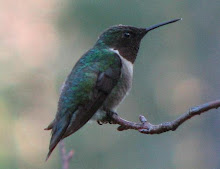
Near the house, 14 hummingbirds were banded this week and most were young males that hatched this spring. The numbers of ruby-throated hummingbirds are still down from previous years.

In early May, we watched a slider turtle bury 18 eggs just outside our bedroom window. This month we are eagerly waiting for the turtle eggs to hatch. We're hoping that the drought we have been suffering through won't affect the developing eggs. We have gotten some relief from the drought, but our rain total is still more than 15" below normal for this year.

Tuesday, June 20, 2006

Nesting Birds, Multiplying Mammals & Irises

It finally rained. We got a 2 day grand total of ½ inch. When you add the ½ inch that we got last week you get what we should have had each week this spring. The temperature has been in the 90’s and summer doesn’t officially start until tomorrow.

Our regular Tuesday morning hummingbird session was unproductive again with a total of zero captures. Hummingbird numbers seem to be down overall. We saw only 2 adult males and 2 immature birds all morning.

Our cavity nesting birds seem to be doing well and we also have a lot of different species of song birds nesting in the yard. For the first time in years we have at least 1 pair of orchard orioles that have raised a family. Besides the mature male and female and their fledglings we have seen a couple of 2nd year males with the yellow coloring and black throat. Each time I go past the lemon bottlebrush plant I see one of the orioles. Orchard orioles were once very common in this area, but their numbers have decreased due to cowbird predation. We have also observed the young of several other species that nest on our property including hooded warblers, eastern towhees, wood thrushes, northern cardinals, mockingbirds, brown thrashers, mourning doves, pine warblers, Kentucky warblers, red-eyed vireos, white-eyed vireos and yellow-throated vireos.

This spring we’ve had a population of mammals, especially cottontail rabbits and cotton rats. We also saw what looked like a young coyote hanging around and coyote droppings were found by the pond. This is not one of the predators that we encourage since they have been known to kill small pets -- just another reason why we keep our pets inside. The drought has brought the armadillos out of the woods to search for grubs in our flower beds.

Many of the shallow parts of our creek have dried up as a result of the drought forcing reptiles to search for food upland. We saw one water moccasin along the trail in the woods yesterday morning and another on our front porch in the afternoon. But we feel that all creatures have their place in the habitat so both snakes were chased back to the creek where they belong.

I gathered the seeds of our native copper iris (iris fulva) and the giant blue iris (Iris giganticaerulea) while the pod was still greenish yellow and pliable and planted the seeds in good potting soil. I’m hoping to get a lot of these beautiful native flowers as they are good nectar plants for hummingbirds.

Tuesday, June 13, 2006

Prothonotary Warblers, Great Crested Flycatchers & Eastern Bluebirds

This morning we attempted to band ruby-throated hummingbirds. This is a very inactive time for banders, when trapping is difficult due to the large number of flowers blooming - mimosa, Japanese honeysuckle, lemon bottlebrush and trumpet creeper, to name a few. The female ruby-throats have also been tending their first nests. A few juveniles have been sighted so in the next couple of weeks the hummingbirds will be plentiful again.

After a slow start, the nestboxes on our small trail had a high percentage of occupancy this year. This was probably due to the fact that most of the natural cavities were knocked down by H. Katrina. Five pairs of Carolina chickadees had successful nests, which was such good news because they haven't been doing well the last few years.

Three different pairs of Prothonotary warblers were successful: 1 in a bluebird box, 1 in a chickadee size box & 1 in an ornamental old barn wood box on our front porch. I have pictures of the pair on the front porch. It looks like they are starting a 2nd nest, too.

A pair of Great Crested Flycatchers built in a screech owl sized box in the vegetable garden and the last of their young are fledging as I write. We found what we think is a great crested flycatcher's nest in box #13. We are unable to check it regularly because you have to scale 4 fallen trees and balance on logs to reach it. It also has never had a nest in it until this year. We considered making it box 12b, but maybe it's not jinxed after all.

After a successful 2nd nesting attempt producing 4 fledglings (I saw them on the wire this a.m.) the eastern bluebirds have laid 4 eggs & the hen is beginning to set in one of the houses from the LA Bayou Bluebird Society.

Tomorrow we check the boxes down in the woods. We're hoping for 2nd nests for the 2 Prothonotary pairs. This a.m. we watched a family of brown headed nuthatches feed their young sunflower seeds. I guess they found a cavity in a dead limb somewhere for their nest. There was another family using the feeder down by the river.

Monday, May 22, 2006

Wildflowers Blooming Out of Season

At a recent meeting of the Folsom Native Plant Society, several members reported that many varieties of fall blooming wildflowers were blooming now. Those early bloomers observed were: Goldenrod, Fall Asters, Mist Flower and the introduced, Crocosmia.

Spring this year has also had unusual weather with several cold snaps well into April and very dry weather. We are currently experiencing a drought and many of the plants that were damaged by Katrina are dying because of the lack of rain. This is the second driest Spring in weather history.

Sunday, April 23, 2006

Eastern Box Turtle Rescue

On the way to the Folsom Native Plant Society Meeting, we observed an eastern box turtle that was nearly hit while it was trying to cross a busy highway. We passed it up, but quickly backed up when no cars were coming and we were able to snatch it from the jaws of death. It is an especially colorful one, with beautiful patterns on its shell. We brought it home and released it on our land.

Thursday, March 30, 2006

Another Katrina Victim

This morning our 15 year old cat, Amphitrite', died. She was so traumitized during Hurricane Katrina and the horrible conditions that we had to live in for 3 weeks after the storm that her health started to decline. I wonder how many older people were affected in the same way that Amphi was. She's been with us so long, that it's hard to believe that she's really gone. She's one more thing that Katrina has taken from us that we can not replace.

Saturday, February 11, 2006

Nest Box Trail Restoration

Our trail is almost restored, we need to repair, replace or move only 3 more boxes. A pair of E. Bluebirds has already checked out Evelyn's hand painted box that we placed in our yard, near the house. Both male & female went in to look around. The Carolina Chickadees were also singing and calling as we replaced the damaged boxes with beautiful new ones.

We couldn't have gotten our trail ready so quickly without Evelyn, Kenny and the LA Bluebird Society. They came to the rescue with the offer of N.A. Bluebird Society approved nest boxes to replace the ones that were destroyed by H. Katrina.

On January 2, 2006 we saw a rufous hummingbird in our yard. It was banded by Linda Beall and identified as a female. She spent the entire winter with us and did not migrate until late March.

Saturday, December 31, 2005

Christmas Bird Count 2005

We participated in the Audubon Society’s Christmas Bird Count for St. Tammany Parish, even though our heart wasn’t in it. Despite the foggy weather we had a pretty good showing. We observed for 5 hours at the feeders and in the woods on and around our property. During the 5 hour period we counted 25 different species of birds.

Our list includes: 1 Red-shouldered Hawk, 21 Mourning Doves, 3 Red-bellied Woodpeckers, 2 Downy Woodpeckers, 4 Blue Jays, 6 American Crows, 7 Carolina Chickadees, 5 Tufted Titmice, 1 Brown-headed Nuthatch ,6 Carolina Wrens, 5 Ruby-crowned Kinglets, 9 American Robins, 6 Pine Warblers, 3 Eastern Towhees, 1 Chipping Sparrow, 8 White-throated Sparrows, 10 Northern Cardinals, 26 Red-winged Blackbirds, 1 Common Grackle, 2 House Finches, 8 American Goldfinches, 1 Eastern Phoebe, 2 White eyed vireos, 3 Wood Ducks, and 1 Pileated woodpecker.

Sunday, October 2, 2005

Nest Box Trail Update

We've come up for air after a month of cutting and clearing fallen trees. We still haven't cut our way to check on all of the houses, but so far about 7 bluebird sized boxes were damaged and our new cypress wood duck box was knocked off the pole and the roof will need repair.

We are very concerned about the number of large black cherry trees that were up-rooted or broken. So many of the cavity nesters use these berries as a food source. We lost many oaks and have pine snags all over our property. To look on the bright side, it opened up the woods more so that more bluebirds may be attracted and the snags will provide places for woodpeckers to nest in the future, but the devastation is hard to believe.

We do have electricity now (ever since Sept. 18th) so we don't have to play generator tag with the water well pump and the refrigerator. It's so nice to be back in civilization, but we'll probably smell like chain saw smoke and wood chips for a couple of years! We were very lucky and our hearts go out to the people and the wildlife in the hard hit areas south of us. Our habitat will rebound. New growth is already sprouting up through the debris. We just need a little rain to clear things out. It was lucky that the storm hit at the end of the breeding season so that no nests were lost. Nestboxes can be repaired.